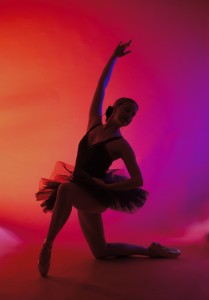
A Ballerina’s Love Affair With Pointe Shoes, Part II.
Once I had purchased my first pair of pointe shoes, the steep uphill climb of the learning curve began. There was a lot to learn: how to sew on the ribbons, care for the shoes, care for the feet in and out of the shoes and, of course, how to use the things. But during the course of the drive home from the dance store, the shoes remained nestled in their box in a mass of tissue paper.
Within moments after getting them home I was ready to sew on the ribbons and give them a test-drive. Proper ribbon placement is essential; one cannot just sew them on haphazardly and hope for the best. To find the right placement, fold down the back of the shoe until it touches the shank on the inside of the shoe. The sites where the satin folds are where the ribbons go. My teacher was very particular and very thorough about sewing those ribbons; she made us fold the ends of the ribbon over on themselves twice before sewing them on. By sewing through several layers of ribbon, there was no way those puppies were ever going to rip off in the middle of something important.
At last we were able to try them out the following week. The final 10 minutes of class were set aside for the pointe shoe fledglings to spread their wings. We were given careful instructions on how to gently bend the shanks so they would curve under our arches and how to break in the boxes so they felt a little bit less like cement blocks. We ripped off a hunk of lamb’s wool (sold by the box), wrapped it around the toes to cushion them, then tied the ribbons in the trademark criss-cross around the ankles.
The first exercise on pointe was simple relevés on two legs, and we only did a few of them. It felt strange and rather anti-climactic. It also hurt. A lot.
Over the next several months we began to build up to doing more and more en pointe and I simultaneously began to have more and more pain in my feet, specifically in the joints of my big toes. Whenever I took my pointe shoes off, my feet would throb in protest, the joints of angry and red. I began to notice they were becoming enlarged. Needless to say, the pain and disfigurement were alarming. I tried putting ice on the affected area but it didn’t help – they kept growing.
I would come to find that nothing would help. Over the course of the many years that followed, my feet would gradually transform themselves into a twisted version of themselves. “The problem is that you need to strengthen the outside muscles of your calves,” said the podiatrist that I consulted (hundreds of exercises later there was no change). “The problem is that your big toes are longer than the others and your foot is warping itself to compensate,” said knowing friends (not much to be done about that). The problem continued to progress and I developed full-fledged bunions (really not pretty).
The real problem was that pointe shoes are actually instruments of torture. Beautiful to look at, but not so fun to get used to.
It took years before the breath-taking pain finally subsided. But for the first few years that I wore pointe shoes, it felt like my feet were being sliced with a hot knife. I’d often have to slip the shoes off for a few moments between exercise to relieve the continual aching pressure. When I finally took them off at the end of class I expected to see steam come pouring out, like in cartoons. Only it was no laughing matter, really. Most of the time I wanted to cry.
I had yet to learn how to dance with open, bloody blisters and to familiarize myself with the wide array of Dr. Scholl’s products that make a dancer’s life just that much more bearable. It wasn’t until years later in New York that I’d learn the tricks of mummifying my toes with medical tape and strategically placing squishy pads around nasty blisters and corns.
Human feet are subjected to a lot but dancers pretty much take the prize for being the most demanding of them.
Two summers ago, a fellow dancer and I were walking together. It was a hot day and I was wearing flip-flops. My friend happened to look down at my feet and commented,”Oh, your poor feet. Look at what pointe shoes have done them.” Her feet, by contrast, looked totally normal and pretty (I was envious).
In the overall scope of things, one could argue that I got off easy. Yes, my feet are somewhat deformed, but I never ripped, tweaked or broke anything. While many dancers end up with injuries that never completely go away, I never suffered anything that still lives with me now.
But in the ballet world, such is the price of glory.
My Love Affair With Pointe Shoes, Part I.

Every young ballerina dreams of the day she will first go up on pointe. Pointe shoes are the stuff of magic, giving a dancer the illusion of floating or flying. (Before pointe shoes were developed, dancers were hoisted into the air on ropes and pulleys… but pointe shoes made it so much easier to move around the stage instead of just up and down). The pink satin gives pointe shoes an air of elegance, conjuring up images of fine ladies strutting about in even finer gowns made of billowing layers of stain and tulle. But in all honesty, wearing pointe shoes takes a lot of getting used to. They hurt like a mother.
I couldn’t wait to get my first pair of pointe shoes. However, my teacher was very particular about starting girls when their bodies were ready and not a moment before. She was a stickler about this because starting a dancer on pointe too early can cause real damage. As I got closer and closer to the right time, my anticipation grew to the point of near explosion. Buying your first pair of pointe shoes was a big deal in my ballet studio, you see; it was like a field trip, a festival and a huge family celebration all rolled into one.
We all drove together as a group on the big day, partly because my teacher wanted to be there to oversee the process and partly because the nearest store to buy them was located forty-five minutes away. We flocked into the tiny store and were seated in a tight little circle. None of us could sit still on the cold metal chairs as we waited for our turn while our friends were fitted. We watched their faces as they rose up on toe for the first time while we anxiously wiggled in our seats.
In my teacher’s mind there was only one brand: Capezio. So that’s what we all got. Size and width were the only thing that differed among us. But on that day there was nothing more wondrous in my mind than those pink Capezios. At last my feet were happily encased in what felt like pink satin cement blocks. My fitter offered me a hand to help me stand up and man, even standing in the things felt awkward. They had absolutely no give and were thicker and taller than ballet slippers. It felt like my ankles couldn’t flex enough to stand properly- my weight was being forced back on my heels, making me feel like I could teeter over backwards. The fitter continued to hold my hand while I rose up on pointe for the first time. The tips of the shoes, called the boxes – the hardest parts of the pointe shoes dug in to the soft, virgin flesh of my feet. It really hurt! I didn’t know how I would ever get used to wearing them, let alone look graceful.
Still, even the pain did not lessen my love affair with those shoes. That would happen much later.
Once everyone was fitted properly (and to my teacher’s satisfaction), the shoes were boxed up and we were all given the standard-issue packs of pink satin ribbon to sew onto our shoes (pointe shoes do not come with the ribbons attached- it is always a dancer’s job to do that… imagine how much sewing professionals do when they go through several pairs of shoes each week) and a box of lamb’s wool, which was used to cushion and protect the toes inside those super-hard boxes.
I was on a huge high during the entire car ride home. I couldn’t wait to sew those ribbons on my shoes and get started with dancing… like a real ballerina. Finally.
Little did I know that my love affair with pointe shoes would be short-lived and tragic.
“Bunheads” by Sophie Flack, Discussed by Another Ballerina

I just finished reading Sophie Flack’s “Bunheads”, a gritty, true-to-life story about Hannah Ward, a nineteen-year-old ballet dancer who has been happily devoting herself to the rigors of ballet life with the prestigious Manhattan Ballet: classes, rehearsals, performances and complicated backstage relationships. When she meets a handsome musician named Jacob, her life changes, and she is forced to decide what she really wants her future to look like.
I have to admit that I felt a little bit ill reading some of the descriptions of Hannah’s life. It all brought me back to my own experiences as a ballet dancer. What many people don’t realize is that the life of a ballet dancer isn’t always pretty; it requires an inhumane level of work and dedication without offering much in the way of fair compensation. Ballet is an all-or-nothing proposition – there’s really no time for much of anything else.
While the practice of ballet has much to offer an individual (like balance, coordination, musicality, spatial awareness and discipline) the lifestyle does not. The dream of becoming a professional ballerina is quite alluring to many who remain ignorant of the cold, hard realities of a dancer’s life. “Bunheads” puts it all in the spotlight.
For instance, many ballet companies require dancers to work six days a week, with Mondays off. That’s more work days than most typical jobs in the country. It’s a well-known fact that a dancer’s pay is not very high, but most people probably don’t know that dancers go on unemployment every year for part of the year since most contracts don’t offer a full year’s worth of work. This is true even for dancers with New York City Ballet, one of the most well-known (and well-financed) ballet companies in the US.
Just as Hannah Ward’s character demonstrates, a dancer’s day starts early (around 9am, when they get ready for the obligatory morning ballet class) and ends late (often after 11 pm, after an evening performance). For most, it isn’t enough to simply show up for classes, rehearsals and performances. The ongoing pursuit of perfection (through extra dance rehearsals, pilates, yoga, and strength training classes) is an integral part of a ballerina’s job description. There’s just enough time to fall into bed exhausted, only to wake up the next day and start all over again.
Let’s not forget the added pressure of maintaining an ultra-slim physique, which is no easy feat to begin with and often involves developing some unhealthy eating habits. Smoking and binge eating are some of the techniques that the characters in “Bunheads” employ to stay thin. One of the principal dancers only eats white foods (and it comes as no surprise when she collapses and ends up in the hospital).
Then, too, there are the people who are in charge of running the whole show. In “Bunheads”, the artistic director constantly pits dancers against on another by giving them the same role, which forces them to compete with one another, upping the ante. There is never a word of kindness or encouragement uttered during the entire length of the book, despite the brutal workload – even after stellar reviews in the newspaper. The environment of the ballet company is highly competitive and completely lacking in positive reinforcement.
Over the years I’ve had several parents ask about how to help their daughters start ballet careers and I’ve advised them to really educate themselves about the realities before making that decision. “Bunheads” might be the perfect required reading.
The Dancing Gourmet: a ballerina’s healthy recipes for fitness
Author: Hymes, Linda
Title: The Dancing Gourmet: Recipes to Keep You on Your Toes!
Publisher: Lindergaff Books, 2002
ISBN: 0971978204
Linda Hymes shares a full repertory of delicious, healthy recipes that are fit for dancers and non-dancers alike. Heck, these are recipes to keep you fit. Hymes knows the secrets of preparing tantalizing dishes that won’t add to your waistline- she trained at the prestigious School of American Ballet in New York City before becoming a professional ballerina for fifteen years. After she retired, she pursued her greatest passion- food- and attended the world-renowned Le Cordon Bleu in London.
The Dancing Gourmet is a perfect marriage of gourmet food and elegant aesthetic. Anyone who loves ballet or who wishes to look like a dancer by eating right will enjoy the mouth-watering, colorful photos of food and Hymes during some of her finest dancing moments- both seem to jump right off the page. The Dancing Gourmet is flavored with humor throughout it pages: the recipes are categorized by ballet’s positions of the feet, from first position (appetizers and small plates) through fifth position(entrees). The final section involves the prerequisite visit to the Land Of the Sweets (a reference from the second act of the much-beloved Nutcracker) which no ballet career or gourmet dining experience should be without.
Eating right doesn’t have to be a punishment. In fact, it can be quite pleasurable. Choices from the third category of salads (not just rabbit food!, according to Hymes) such as the grilled chicken salad with spicy blackberry dressing, thai eggplant salad with pickled garlic, and sole and salmon twirls with maple glaze are appealing, or curried banana balls with masoor daal and cold sesame soba with tofu for the vegetarian crowd. Top it all off with a cup of fresh-brewed chai and a slice of pavlova cake. Brava!
Life Lessons From My Time as a Ballerina

During my recent radio interview about what life as a ballerina was like, memories rushed to the surface, making it all real again. It’s been more than twenty years since I stopped dancing professionally, but it’s an experience I carry with me always. As another ex-dancer colleague recently commented, “Dancers stand out in a crowd”. There are reasons for this. Dancers are very physical creatures. After so many years of intensive training, our bodies are shaped differently, and move differently. Grace has been ingrained and at the forefronts of our brains for decades.
Although I chose to move on from ballet as a career choice, I am grateful for the years I spent dancing, for other reasons besides the obvious. So many of the things I learned as a dancer are directly applicable in every other aspect of my life, from parenting to poetry:
1.Discipline and dedication. Continuing to show up gets you where you want to go. As a freelance writer, nothing happens unless I apply myself.
2.Memory skills. As a dancer, I had to remember where and when every step happened. As a working single parent I change hats constantly, and have to remember a lot. I once counted how many items I had to remember before breakfast was even served…let’s just say it was a heckuva lot more than seven impossible things.
3.How to take care of my body. The body is how we get around in the world. If our vehicle is constantly low on gas, or runs in fit and starts, everything else we do is affected… and compromised.
4.Practice makes perfect. Skills build over time. Any time applied in a given task will pay off in the long run. This is true in everything, from hula hooping to learning to play an instrument.
5.Mistakes are learning tools. No one performs perfectly all of the time. Mistakes are part of life, and learning from them helps us to grow.
6.Always do your best. There is great peace of mind knowing that you are giving something your all. No one can ask any more of you than that.
7.Keep a good attitude. Life is a lot more fun when you approach it with a good attitude. Sometimes attitude alone can carry you through difficult times.
8.Growing and improving are lifelong processes. There is always room to improve. This doesn’t mean mentally whipping yourself, but looking for ways to strengthen yourself in areas that are challenging.
9.It’s okay to ask for help. Sometimes there are questions we can’t answer, challenges we are up against, or things we’d like to do that we can’t do alone. Asking for help is a sign of strength of character, and it doesn’t hurt…you or anyone else.
10.Each of us has unique gifts. There has not and never will be another you. No one does things the way that you do. Find a way to share your unique gifts with others, and everyone benefits.
We can do whatever we dream about…if we believe we can.
Listen to my interview about life as a ballerina HERE.
ballet goes graphic
May 24, 2010 by admin
Filed under must-haves

Title: to dance: a ballerina’s graphic novel
Author: Siena Cherson Siegel, Illustrator: Mark Siegel
Ages:8-12
Publisher: Atheneum Books For Young Readers, 2006
ISBN: 978-0689867477
The world of a young ballerina springs to life on the pages of this colorful, gripping tale. Each page details the daily routines, thoughts, and dreams of a dancer as she moves to New York City to study at the School of American Ballet.
A fantastic read for anyone who loves ballet and wonders what the life of a dancer is like, the graphic novel format makes the story all the more real. George Balanchine, partnering class, pointe shoes, schoolwork, and the hum of New York are only part of the picture. In the end, the love of dance is what shines through.