Tag Archives: yoga

Dance Injuries and What To Do About Them

Dance Injuries and What To Do About Them


Dancers are some of the most athletic people on the planet yet dance, especially ballet, takes a toll on dancers’ bodies over time. Let’s face it – some positions are completely unnatural and require us to tweak things, especially our spines, to create the desired effect. Many dancers deal with injuries throughout their careers; many more have ongoing issues after they stop performing. Although I was relatively injury-free throughout my career, I had (and continue to have) back issues. It’s all got me wondering: what’s a dancer to do?


There are a number of healing options to turn to, depending on the type and severity of your injury.

1. Physical therapists. Miami City Ballet, like many other companies, had a therapist on site to help dancers when they got hurt. Therapists offer a range of ideas, from simple (like icing or massage) to more in-depth (rehab exercises to strengthen injury-prone areas). Best thing I ever learned from a therapist: contrast baths. Alternate icing and hot water on the injured area to stimulate blood flow and healing.

2. Chiropractors. There is no one way to realign tweaked body parts. Some chiropractors use more active force, others opt for a more gentle method. I have had varying degrees of success with chiropractors and generally use them for things like not being able to turn my head all of a sudden.

3. Massage. Who doesn’t love a good massage? A gentle Swedish-style massage will help the body relax while a deeper, therapeutic massage can work out the tight kinks. I’m currently looking into Rolfing as an option for recurrent issues.

4. Acupuncture. I was lucky enough to study with Merrill Ashley, (awesome dancer and teacher) who swore by acupuncture for back issues… Since then I’ve used acupuncture for everything from colds/flu to post childbirth.

5. Yoga. If nothing else, yoga’s calming influence is a good counterpart to the stress dancers live with. As I get older, I’ve come to rely on yoga as a sanctuary and a way to maintain flexibility. A flexible body is less prone to injury.

6. Pilates. Core strength was always my achilles heel (thanks Mom) until a friend turned me on to Pilates. I also noticed a huge improvement in my overall strength. Sadly, I had to abandon the practice for decades because of time, expense, etc but recently bought a home reformer and love it.
7. Foam rollers, massage roller balls. Many dancers swear by these tools. Since we can’t go running off for a massage every other second, these tools help you iron out those hard-to-reach spots. Yoga Journal recently wrote up this how-to.
Of course nothing keeps the body injury-free better than thoroughly warming up and paying attention to internal cues (i.e. pain). We only get one body this lifetime (unless the cloning thing works out in the near future), so treat it right.


Share on Facebook+1Pin it on Pinterest

Strength Training For Dancers and Non-Dancers

Strength Training For Dancers and Non-Dancers


yoga 

Dancers are known for their strength and grace, but they don’t come without hard work. In addition to daily dance classes and rehearsals, dancers build strength through alternate methods such as yoga and Pilates. Both of these practices give dancers the extra boost they need to be better, stronger dancers and move ahead in their careers.


Yoga teaches practitioners how to link breath and movement, which is a very powerful tool for dancers. Working with conscious breathing adds more power to certain moves such as turns and jumps. An in breath helps with expansive moves and buoyancy – helpful when it’s time to leap across stage, while an out breath adds power to bends or grounded moves. Yoga teaches us how to live more fully in our bodies, to inhabit each and every cell while building strength, balance and coordination.Yoga has another obvious benefit; a relaxed state of mind.What dancer couldn’t use a little of that? Let’s face it; dancing is a very stressful career.

Says dancer Jennifer Stahl: In yoga (especially vinyasa) I was finally able to find a feeling of fullness to my movement—something I had struggled to attain in modern class, but never quite “got.” Once I became used to finding length in every position during the slow flow through the poses, I could translate that sensation back to the studio, and became able to move bigger, with longer lines. Yoga taught me to really feel what was going on in my body, and to become aware of where I was placing it in space.


Core strength is a key element for dancers, especially during quick moves and turns. Joseph Pilates, a fitness pioneer in his time, developed the Pilates system, which uses specialized equipment and exercises to develop and strengthen what he called the “powerhouse”, the muscles of the abdominals, lower back and buttocks. Other benefits include improved posture, and fewer back problems. The Pilates method has long been an inside secret for many dancers, but is now recognized as important and necessary- Pacific Northwest Ballet has two Pilates studios available to its dancers. (Read more about Pilates at PNB here).

Says Alexandra Dickson, ex-PNB soloist and Pilates Conditioning Manager at PNB: “I didn’t realize the power I was getting from Pilates until I did it three times a week after my pregnancy,” recalled Dickson during a recent break from private and semi-private workouts with clients. “I got back to the ballet and we opened with ‘Swan Lake’ (a demanding performance). I couldn’t have a made it back without the Pilates work.”


However, yoga and Pilates aren’t just for dancers; anyone can benefit from either practice. Both are particularly helpful to prevent and correct back pain issues. The benefits include:


Yoga

• greater strength and flexibility

• improved balance and coordination

• improved state of mind

• increased breathing capacity


Pilates

• improved posture

• greater core strength

• improved overall strength, flexibility and coordination


Strength and grace don’t come naturally, but there are tried and true techniques available for anyone (dancer or not) who wants more of either.


Share on Facebook+1Pin it on Pinterest

“Bunheads” by Sophie Flack, Discussed by Another Ballerina

“Bunheads” by Sophie Flack, Discussed by Another Ballerina

Flack_BunheadsHC-200x300

I just finished reading Sophie Flack’s “Bunheads”, a gritty, true-to-life story about Hannah Ward, a nineteen-year-old ballet dancer who has been happily devoting herself to the rigors of ballet life with the prestigious Manhattan Ballet: classes, rehearsals, performances and complicated backstage relationships. When she meets a handsome musician named Jacob, her life changes, and she is forced to decide what she really wants her future to look like.


I have to admit that I felt a little bit ill reading some of the descriptions of Hannah’s life. It all brought me back to my own experiences as a ballet dancer. What many people don’t realize is that the life of a ballet dancer isn’t always pretty; it requires an inhumane level of work and dedication without offering much in the way of fair compensation. Ballet is an all-or-nothing proposition – there’s really no time for much of anything else.


While the practice of ballet has much to offer an individual (like balance, coordination, musicality, spatial awareness and discipline) the lifestyle does not. The dream of becoming a professional ballerina is quite alluring to many who remain ignorant of the cold, hard realities of a dancer’s life. “Bunheads” puts it all in the spotlight.


For instance, many ballet companies require dancers to work six days a week, with Mondays off. That’s more work days than most typical jobs in the country. It’s a well-known fact that a dancer’s pay is not very high, but most people probably don’t know that dancers go on unemployment every year for part of the year since most contracts don’t offer a full year’s worth of work. This is true even for dancers with New York City Ballet, one of the most well-known (and well-financed) ballet companies in the US.


Just as Hannah Ward’s character demonstrates, a dancer’s day starts early (around 9am, when they get ready for the obligatory morning ballet class) and ends late (often after 11 pm, after an evening performance). For most, it isn’t enough to simply show up for classes, rehearsals and performances. The ongoing pursuit of perfection (through extra dance rehearsals, pilates, yoga, and strength training classes) is an integral part of a ballerina’s job description. There’s just enough time to fall into bed exhausted, only to wake up the next day and start all over again.


Let’s not forget the added pressure of maintaining an ultra-slim physique, which is no easy feat to begin with and often involves developing some unhealthy eating habits. Smoking and binge eating are some of the techniques that the characters in “Bunheads” employ to stay thin. One of the principal dancers only eats white foods (and it comes as no surprise when she collapses and ends up in the hospital).


Then, too, there are the people who are in charge of running the whole show. In “Bunheads”, the artistic director constantly pits dancers against on another by giving them the same role, which forces them to compete with one another, upping the ante. There is never a word of kindness or encouragement uttered during the entire length of the book, despite the brutal workload – even after stellar reviews in the newspaper. The environment of the ballet company is highly competitive and completely lacking in positive reinforcement.


Over the years I’ve had several parents ask about how to help their daughters start ballet careers and I’ve advised them to really educate themselves about the realities before making that decision. “Bunheads” might be the perfect required reading.


Share on Facebook+1Pin it on Pinterest

Beat Stress: Five Steps to Use Yoga to Relax and Beat Stress

Beat Stress: Five Steps to Use Yoga to Relax and Beat Stress

In today’s world of multi-tasking mania, we have all become super-stressed superheroes. However, in five to ten minutes, a simple regenerative yoga technique can help anyone completely relax and re-energize. Follow these five steps anytime for the perfect tonic to counteract fatigue, stress, or a generally hectic day.

Step 1: Unplug. Turn off all ringers and any device that beeps, blips or vibrates. Instead, choose quiet music if that helps you relax, or just plain quiet works, too.

Step 2: Find a quiet space. It is important that you can rest without being disturbed. Inform family members or coworkers that you will be unavailable for the next ten minutes. Close the door to give yourself privacy.

Yoga1

yoga2

yoga3

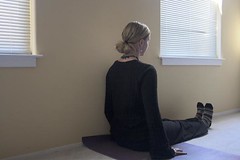
Step 3: Assume the position. Find a three-foot wide section of blank wall space and lay a towel or yoga mat on the floor directly in front of it. Seat yourself, with your left side facing the wall, hip touching the wall, legs extended in front of you. Shift your weight back onto your elbows and simultaneously swing the legs straight up the wall. Press through the elbows and move your bottom up against the wall, then lay your upper body flat. At this point, your body will be in an “L” shape up against the wall. Let your arms rest gently on the floor, palms up.

Step 4: Slow it down. Close your eyes and breathe as slowly and deeply as you can. Listen to the sound of your breath as it flows in and out of the body, making it as smooth and even as you can.

Step 5: Let it all go. Set a timer if you need to, and then give yourself a mental vacation while you are resting. Set aside all thoughts, responsibilities and the dreaded to-do list. Place all the focus on breathing deeply, and imagining the breath is releasing any tense areas. Feel the body being held by the floor.

Following these five simple steps to perform this easy yoga pose, inverting with your legs up the wall, can yield powerful results. You will be amazed at how much better you feel when you give yourself the gift of truly relaxing.

Share on Facebook+1Pin it on Pinterest